Physics Colloquium: "Probing the Structures of Pyramids Using Cosmic Ray Muon Tomography"
About this Event
140 Sims Drive, Syracuse NY 13210
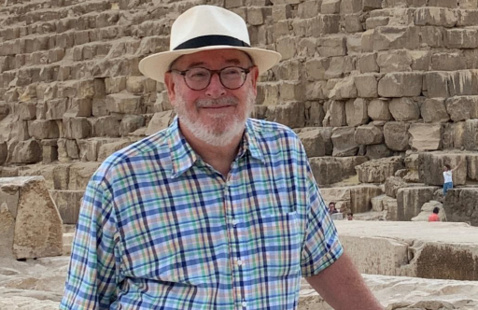
The Department of Physics is pleased to welcome E. Craig Dukes, experimental elementary particle physicist and professor of physics at the University of Virginia, for his talk titled, "Probing the Structures of Pyramids Using Cosmic Ray Muon Tomography."
Bio: Edmond Craig Dukes is an experimental elementary particle physicist and professor of physics at the University of Virginia. He has held appointments at many of the major particle physics laboratories throughout the world, including Brookhaven National Laboratory, European Organization for Nuclear Research (CERN), the Fermi National Accelerator Laboratory (Fermilab), Lawrence Berkeley National Laboratory and the Superconducting Super Collider. He is the author or co-author of over two-hundred scientific publications and is currently engaged in searching for dark matter and new physics with three particle physics experiments: NOvA, Mu2e, and LDMX. In his spare time, he is also working on efforts to probe the interiors of the Great Pyramid of Khufu in Giza, Egypt and the Temple of Kukulkan at Chichen Itza, Mexico.
Abstract: The pyramids of ancient Egypt and of pre-Hispanic Mesoamerica have fascinated people since the cultures that built them vanished into the annals of history. How were they built? What were they used for? Are there unknown internal substructures, perhaps hidden chambers that have yet to be discovered? Using the detector technology we developed for a particle physics experiment at Fermilab, we intend to perform non-invasive searches for hidden structures at the Great Pyramid of Khufu in Egypt and at the Temple of Kukulkán at Chichén Itzá. The apparatus will detect cosmic-ray muons produced high in the atmosphere that course through the pyramids to produce a tomographic image of their interiors. I will describe in detail the technique we are using, present simulation studies, detector prototype results, and the status of both experiments.
Event Details
See Who Is Interested
0 people are interested in this event